One-At-A-Time Mode of Experimentation
By far better than "Panic approach" but still not ideal, this is also a method of experimentation. Different levels of a control factor (say, A1 & A2) are compared while all other control factors remain fixed at a predetermined level (say, B1 & C1). Conclusions resulting from such experiments, whilst providing some basis for comparisons, suffer from a number of shortcomings, mainly,
- Integrity Of Results When B1 & C1 Change To B2 & C2
- Its Inability To Study Interaction Effects
- Inability To Distinguish True Effects From Process-Inherent Random Variations or From Noise Factors, Thus More Susceptibility To Variability
Different levels of the control factors may often weaken or strengthen certain observed trends, or even reverse them. This occurs when control factors interact with each other. Other uncontrollable factors (noise) may also have the same effect. Interactions and noise can have significant influence on the output of our processes.
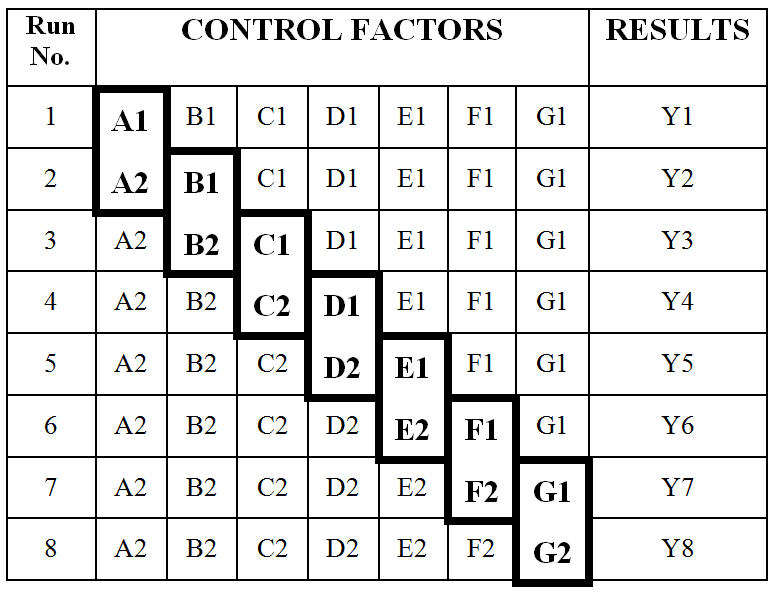
One-At-A-Time Methodology
The Table above shows how "experimental comparisons" in the One-At-A-Time methodology are made. Run No.1 with all control factors set at their first level results in the first experimental observation, Y1. For run No. 2, the level of only one control factor (A) is changed (hence One-At-A-Time), and Y2 is recorded. The difference between Y1 and Y2 represents the effect of A, as it was the only control factor that did not remain constant. For run No. 3, control factor B is changed from level B1 to B2. Comparison of Y2 and Y3 should indicate the effect of control factor B, and so on.
One-At-A-Time experiments can be expensive and time-consuming as they require large numbers of experimental runs. It has been favoured because it is intuitively understood without the need for statistical knowledge and can also be applied whilst the process is still running without major disruption and pre-planning. It, however, does not show the effect of a control factor in relation to varying levels of other control factors thereby its inability to establish long term optimum conditions. Drifts are inevitable, and realising the so-called optimum performance is only possible through continuos One-At-A-Time experimentation.
► Click here to go back to the list of "Possible routes for Experimentation"
|