Working Mechanics of D.O.E
Page 1 / 5 >>>>>>
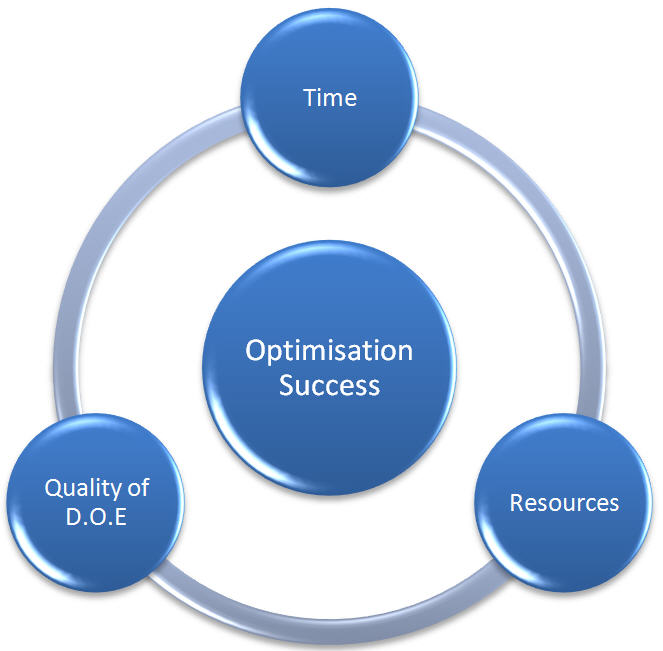
D.O.E requires only a limited set of experiments thereby helping to reduce optimisation costs. Of course, the trade-off between size of the experiment (time & Resources) & the degree to which the process needs to be controlled, is one that has to be decided by "process-owner", at the earliest possible stage.
A carefully constructed D.O.E performed under controlled conditions usually involves the following steps,
-
DECIDE on the objective of the investigation, e.g. "process-screening" or "finding optimum conditions"
-
DEFINE the control factors for the experiment, and their levels or ranges appropriate to the objectives
-
DEFINE the output of the process and its optimisation criteria
-
CHOOSE an appropriate Orthogonal Array, i.e., one that reflects the objective, number of design variables and precision of measurements, and has a reasonable cost in terms of the number of required experimental runs
-
CONDUCT the experiment, collect data & identify significant factors
-
ESTABLISH optimum conditions, predict performance, & run confirmation runs
-
If not satisfied with the optimisation level, repeat the a 2nd loop D.O.E (as a "zooming-in" exercise).
|