Fractional Factorial Experiments
D.O.E utilises the concept of fractional factorial experimentation, through orthogonal arrays. Orthogonal arrays are experimental matrices, devised by Fisher in 1940's. An orthogonal array matrix allows "mathematically independent” assessment of the effect of all experimental factors.
A simple example to illustrate orthogonal arrays would be the following :-
"Imagine the World Cup Football Tournament.......because it is not simply possible to organise a match between any given pair of participating teams (i.e., full factorial), Group Tables are devised. These are in effect orthogonal arrays to ensure a limited (i.e., fractional factorial), yet fair, structure under which numerous participants can confront one another, in order
to progress through the qualifying stages."
The same should apply to the way that different control factors levels are chosen to form a particular run of an experiment, if accurate results are to be obtained in a repeatable manner.
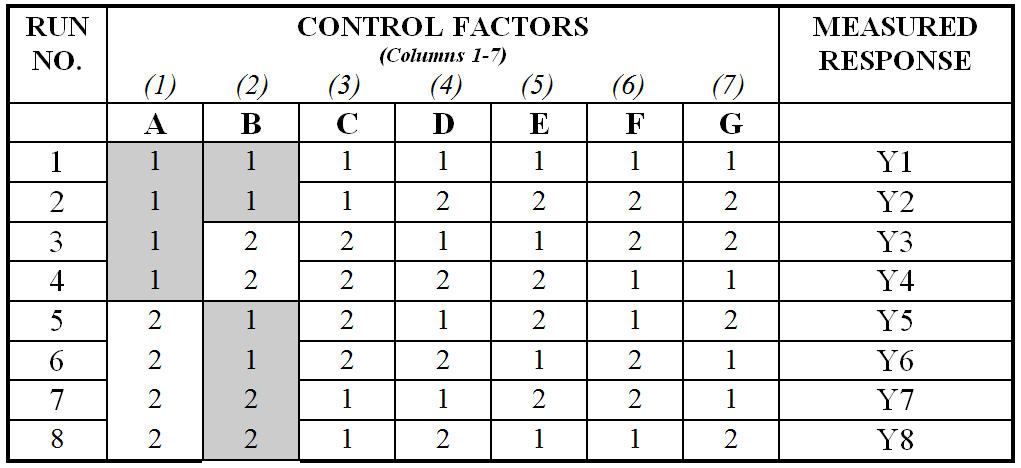
Table above shows a typical fractional factorial experiment involving 7 control factors at 2 levels. A full factorial scenario for such a case would involve 128 experiments (2 to the power 7). Fractional factorial D.O.E reduces the number ofruns required to ONLY 8!
► Click here to go back to the list of "Possible routes for Experimentation"
|